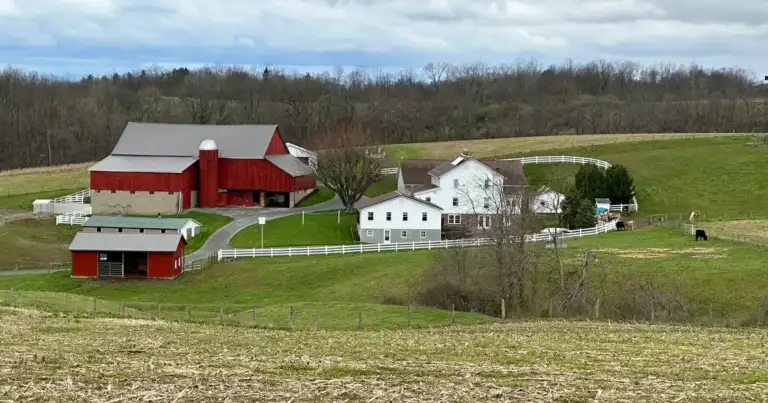

The Premium Value of Ohio Soil
For those of us who appreciate the enduring value of Ohio, our agricultural sector is a cornerstone. Let’s be clear: this isn’t merely about acres; it’s about legacy. Our farms contribute over $100 billion annually and employ one in seven Ohioans. This isn’t just about statistics; it’s about the deep-rooted pride in our state’s ability to feed itself, to cultivate land that has sustained families for generations. As Sarah Jenkins, President of the Ohio Farm Bureau Federation, rightly stated:“This isn’t about public roads or schools; this is about private companies taking our land for their profit. Where do we draw the line?”Indeed, the line has always been drawn at public utility. Eminent domain, a necessary evil in its purest form, has historically been reserved for roads, schools, and infrastructure truly serving the collective good. HB 789 doesn’t just blur this line; it obliterates it, potentially allowing corporations—driven by pure profit—to dictate the future of private property. David Chen, an Ohio farmer, articulated the raw truth during Senate testimony:
“My family has farmed this land for five generations. If they can just take it for a server farm, what’s next? What’s the point of owning property?”His question cuts to the core of what it means to be a landowner in Ohio.
The Steep Cost of “Progress”
Proponents, like State Representative Michael Vance, champion the bill as a means to “attract critical investments and high-tech jobs.” They tout the $5 billion in data center investment Ohio has seen in the past five years. Yet, we must ask: at what cost? A shiny façade of “high-tech jobs” hides a devastating reality. Data centers are notoriously water-intensive, consuming millions of gallons daily. They gobble up vast tracts of land, contributing to the 15,000 acres of Ohio farmland already lost annually to development. And what kind of jobs are we truly talking about? Often, it’s a temporary construction boom followed by a handful of specialized, highly technical positions that do little to support local economies in the long term. This isn’t sustainable “economic development”; it’s a short-sighted exchange of irreplaceable natural capital for ephemeral digital infrastructure.Let’s be brutally honest: this isn’t about making Ohio a “leader in the digital economy.” It’s about making it easier for colossal tech companies to acquire cheap land, often at a fraction of its true generational and sentimental value, with the state’s full legal muscle behind them. The “statewide significance” clause is a convenient legal fiction designed to bypass local resistance and expedite corporate expansion. This bill is a direct assault on the fundamental principle of private property, favoring the speculative profits of a few over the enduring legacy of many. It’s a classic power play, using the promise of “jobs” to mask a mechanism for government-sanctioned land appropriation for private gain.
If this bill passes, the path for future industrial encroachment on private land becomes alarmingly clear. A state-level board, accountable to no one but its own agenda, could designate almost any large-scale project as “statewide significant,” effectively stripping local communities and individual landowners of their power. While “just compensation” is mandated, it rarely accounts for the priceless heritage, the lost livelihood, and the emotional toll on families forced from their ancestral lands. This isn’t compensation; it’s a consolation prize for a forced eviction. Ohio has always prided itself on its rich agricultural bounty and the resilience of its landowners. This proposal doesn’t just threaten; it *demands* we sacrifice that enduring legacy for sterile server farms. The time for polite debate is over. It’s time to demand, unequivocally, that our legislators protect the true premium value of Ohio – its irreplaceable land and the families who cultivate it. The choice before us is stark, profound, and irreversible: preserve our deep-rooted heritage, or pave over it for the fleeting, hollow promise of digital supremacy.Photo: Wikimedia Commons (query: Ohio farmers)
Source: Google News