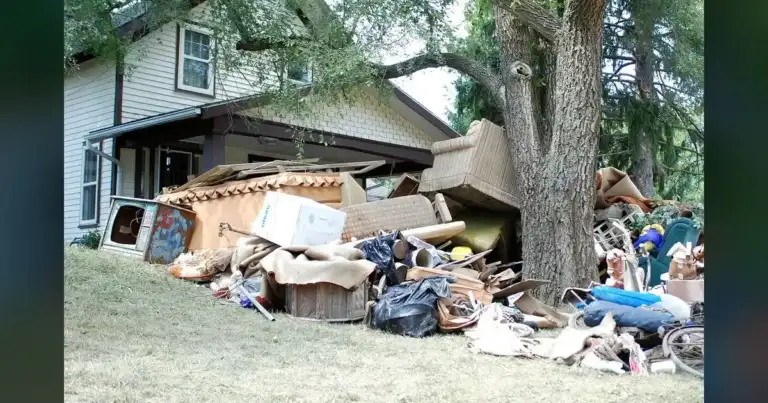

The darkness descended again, thick and unwelcome, plunging tens of thousands across Northeast Ohio into a miserable, powerless limbo. Another storm, another blackout. For the last 48 hours, our fragile modern lives have been brutally exposed as the power grid decided, once again, to take a nap.
Over 60,000 FirstEnergy customers, from Cuyahoga to Ashtabula, found themselves stranded without power after severe thunderstorms ripped through on Monday evening. As of Wednesday morning, a staggering 18,500 are still waiting. They are sweating through sweltering homes, watching refrigerators slowly die and their contents turn to waste.

FirstEnergy, through its Ohio Edison and Cleveland Electric Illuminating Company (CEI) arms, is performing its usual, tired song and dance. Crews are working “around the clock,” they “understand the frustration,” and they “appreciate our customers’ patience.”
Sounds great on a corporate press release, doesn’t it? But out here in the real world, residents like Maria Sanchez from Cleveland Heights are left charging phones in sweltering cars. They wonder when they can actually use their own homes again.
For our elderly neighbors, or those relying on critical medical equipment, this isn’t just an inconvenience. It’s a terrifying, genuine risk that demands immediate attention, not platitudes.
The Same Old Story: Why Northeast Ohio Consistently Folds
Here’s the frustrating rub: we’ve heard this exact narrative countless times. After a devastating summer derecho in 2023, after a crippling ice storm in 2021 – the script is identical. High winds, heavy rain, trees on lines.
It’s not just predictable; it’s practically a seasonal ritual of exasperation. So, why does Northeast Ohio consistently buckle and fold like a cheap suit every time the weather gets a little rough?
The answers aren’t new, but they bear repeating because, despite the rhetoric, nothing fundamentally changes:
- Aging Infrastructure: A significant chunk of our power grid is older than your grandpa’s socks. We’re talking about overhead lines and substations, decades past their prime, simply not built to withstand the kind of increasingly intense storms we’re now experiencing year after year. It’s a relic, not a robust system.
- Vegetation Management: Sure, FirstEnergy trims trees. But they do the bare minimum. The region’s dense canopy, combined with unprecedented storm force, means branches still come down hard on lines. It’s a perpetual game of whack-a-mole they’re barely playing.
- Increased Storm Severity: Climate scientists aren’t whispering anymore; they’re shouting from the rooftops. Stronger thunderstorms, higher wind gusts, more frequent extreme weather events – this isn’t an anomaly; it’s becoming the undeniable new normal for the Great Lakes region. Our grid needs to adapt, or we’ll continue to pay the price.
FirstEnergy’s “Smart Grid” Mirage
FirstEnergy will proudly tell you they’ve got “Smart Grid” initiatives – smart sensors, automated reclosers, substation upgrades. All designed, they claim, to make the grid more resilient. And that’s fantastic, in theory.
But these are multi-year projects, costing billions. Their full, promised impact is still years away, perpetually just over the horizon.
In the meantime, while the utility touts its future-forward vision, people across Northeast Ohio are sitting in the dark, again. They are wondering if “smart” actually means “effective.”
THE RED MARKER: Let’s be brutally, unapologetically honest. FirstEnergy is a utility, yes, but first and foremost, it’s a corporation. And like any corporation, it prioritizes profit above all else. “Smart Grid” sounds good in an annual report, but truly hardening the entire grid – burying lines where feasible, replacing ancient, crumbling infrastructure proactively, and aggressively managing vegetation to a standard that actually withstands these new, brutal storms – costs a fortune. A fortune they’d rather pass directly onto you in rate hikes, or, even better for them, avoid spending altogether if they can get away with it. The Public Utilities Commission of Ohio (PUCO) is theoretically our watchdog, but how much genuine, impactful pressure are they really applying beyond rubber-stamping incremental, slow-burn investment plans? The uncomfortable truth is, it’s demonstrably cheaper for FirstEnergy to deploy crews ‘around the clock’ after a disaster, issue a few sympathetic press releases about their tireless efforts, and let customers suffer for a few days, than it is to make the massive, preventative investments that would genuinely future-proof the grid. Until that financial calculus fundamentally changes, expect this exact same infuriating story to repeat with every major storm.
What Will It Take to Fix This?
The solutions aren’t rocket science, but they require political will and a genuine commitment from FirstEnergy that extends beyond quarterly earnings reports. The PUCO needs to evolve from a passive observer to an aggressive enforcer. They must demand tangible, measurable improvements with real penalties for inaction.
It means a public outcry so sustained and undeniable that the cost of not fixing the grid becomes higher than the cost of actually doing it right. We, the customers, pay for this service. We deserve a reliable one, not a grid that collapses with every gust of wind.
So, as the lights slowly flicker back on for the remaining 18,500, let’s be clear: this isn’t just “bad luck” or “unpredictable weather.” It’s a systemic vulnerability, a direct consequence of deferred maintenance and profit-driven priorities.
Until someone – the regulators, the public, or perhaps even the state legislature – forces the hand of the power company to make the real, costly changes needed, Northeast Ohio will remain a sitting duck. It will be perpetually at the mercy of every severe storm that rolls through.
How many more nights in the dark will it take before we demand more than just ‘patience’?
Source: Google News