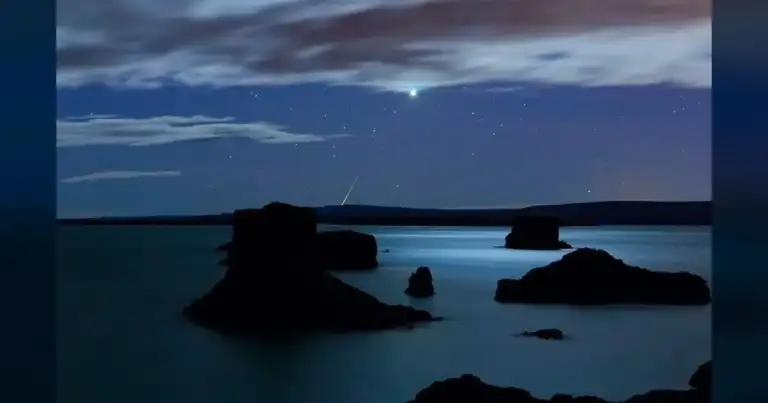

Ames Not Only Awe: The Fireball Over Connecticut Illuminates More Than Skies
On the evening of April 6, 2026, residents across Connecticut were treated — and perhaps startled — by an extraordinary celestial event: a brilliant fireball streaking across the twilight sky at an astonishing speed of 30,000 miles per hour. This fleeting spectacle, visible only for a few seconds, quickly became the talk of the state, lighting up social media feeds and prompting multiple calls to NASA’s Near Earth Object (NEO) program. But beyond the immediate awe and viral videos lies a deeper story — one that touches on science, community, and the ongoing challenge of living under a cosmic sky.
A Momentary Flash, A Lasting Impact
What NASA has now confirmed, through data gathered by its All Sky Fireball Network cameras and analyses conducted at the Jet Propulsion Laboratory, is that this fireball was no ordinary shooting star. It was a meteoroid — an asteroid fragment roughly one meter in diameter — entering Earth’s atmosphere at approximately 48,000 kilometers per hour (30,000 mph). At around 40 miles above ground, the meteoroid fragmented spectacularly, creating a rare and vivid display of cosmic fireworks. This breakup not only illuminated the Connecticut sky but also provided scientists with a valuable natural laboratory to study meteoroid atmospheric entry and fragmentation.
This event’s velocity and brightness distinguish it as one of the fastest and most brilliant fireballs recorded in recent Connecticut history. Though lasting only 3 to 5 seconds, its visible path from western to eastern Connecticut was captured on dashcams, security cameras, and countless smartphones, offering a trove of real-time observational data for researchers.
Science on the Ground and in the Sky
From a scientific standpoint, such events are far from mere curiosities. Each meteoroid passing through our atmosphere carries critical clues about the composition and behavior of small solar system bodies. NASA’s detailed investigation helps refine models predicting how these objects sho uld behave when encountering Earth’s atmosphere — an essential step for improving impact risk assessments.
Moreover, there is ongoing analysis to determine if any meteorites survived the fiery fragmentation to reach the surface. Local authorities have been alerted, and rural areas in Litchfield and Hartford counties are under particular scrutiny. Should fragments be recovered, they will offer a tangible sample from space — a direct link to our solar system’s ancient past.
Community Response: Awe, Curiosity, and Concern
For Connecticut residents, the fireball generated a spectrum of emotions. Many expressed pure wonder, sharing videos and photos that captured the glowing streak. It sparked conversations that connected communities around a shared experience written across the heavens. At the same time, some voiced concerns about safety and the possibility of debris causing damage. Local agencies have responded swiftly, providing reassurance while preparing for any necessary meteorite recovery efforts.
Yet, it is important to recognize that not all voices are equally amplified. Rural communities, which may face the direct impact of any fallen meteorite debris, often lack the same resources and visibility enjoyed by urban centers. Ensuring these areas have access to scientific collaboration and public education is imperative. This event underscores the need for broader outreach and inclusivity in cosmic event preparedness and response.
Looking Forward: A Reminder and an Invitation
While fireballs are rare enough to captivate us, they are also a sobering reminder of the dynamic environment our planet inhabits. Earth moves through space crowded with debris, some small, some potentially hazardous. Events like this Connecticut fireball provide vital data to help safeguard our future and deepen our understanding of the cosmos.
For residents, the fireball was a fleeting messenger from space — a dramatic flash of light reminding us that we share our skies with the universe’s grand celestial dance. For scientists, it was an opportunity to observe natural phenomena at speeds and altitudes impossible to replicate in labs. For communities, it was a chance to unite in wonder and to reflect on our place in the cosmos.
“Every fireball that graces our skies is both a spectacle and a scientific gift,” said a representative from NASA’s Jet Propulsion Laboratory. “It encourages us to look up, to learn, and to prepare.”
As investigations continue and the search for meteorites proceeds, Connecticut can take pride in being part of a narrative that extends far beyond state lines — a narrative that connects human curiosity with the vast expanse of space. Let this event not only inspire gazes skyward but also encourage us to think critically about science, safety, and our shared cosmic heritage.
Photo: Photo by lrargerich on Openverse (flickr) (https://www.flickr.com/photos/29638083@N00/9576666459)
Source: Google News