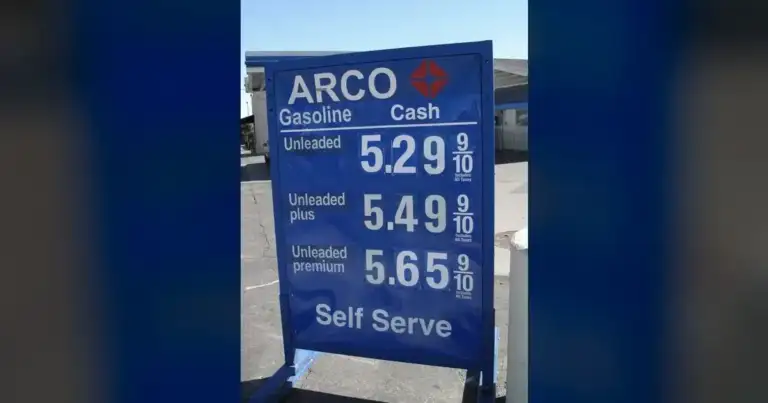

The price at the pump isn’t just rising in South Dakota; it’s rocketing, hitting our wallets with the sudden, brutal force of a prairie hailstorm. The rumble of a pickup, the hum of a tractor cutting through prairie dust – these authentic rhythms of South Dakota now come with a sharp, unwelcome spike in cost, directly impacting every resident and every enterprise that defines our premium way of life.
The Steep Climb: What’s Happening at the Pump
Just days ago, a gallon of regular unleaded in South Dakota sat at around $3.60. Today, as of May 1, 2026, we’re staring down an average of $3.95. That’s a roughly $0.35 jump in 72 hours, a nearly 10% increase that lands hard on the wallets of those who rely on the road. This isn’t just an inconvenience; it’s a direct hit to the daily grind of our state’s economy.

This abrupt escalation isn’t some localized anomaly. Global crude oil prices have rocketed, with West Texas Intermediate (WTI) futures breaching the $85 per barrel mark after a 5% surge. The reasoning? A volatile brew of global instability in the Strait of Hormuz and an “unscheduled reduction in output” from a major non-OPEC+ producer, shrouded in the usual corporate doublespeak of “maintenance issues.” Let’s be frank: we all know what “maintenance issues” often mean in the high-stakes world of global energy – a convenient excuse for price gouging.
South Dakota’s Unique Strain: More Than Just a Commute
For a state like ours, where vast distances are a daily reality, this isn’t just about topping off a sedan. It’s about the very pulse of our economy, the lifeline of our rural communities. What happens when the cost of simply existing becomes prohibitive?
Think of Mary Jensen, the rancher from Harding County, who rightly points out,
“Every penny counts when you’re driving 50 miles just to get to the nearest town for groceries. This isn’t just an inconvenience; it’s a hit to our bottom line.”
Her words echo the sentiment across our agricultural heartland. Farmers are already watching razor-thin margins, and now face increased fuel expenses for planting season and transporting their goods to market. It’s a cruel squeeze on those who feed us all.
John Peterson, a Sioux Falls gas station owner, sums up the retail side succinctly:
“We’re seeing an immediate pass-through of crude oil costs. There’s not much margin in gas, so when our cost goes up, the pump price has to follow.”This isn’t about local gouging; it’s the cold, hard logic of a supply chain responding to global market shocks, a chain where the local business owner is just another link feeling the pressure.
The Ripple Effect on Our Economy: A Financial Tsunami
The consequences extend far beyond the gas tank; this ripple effect isn’t just a metaphor, it’s a financial tsunami. Higher transportation costs mean higher prices for everything from groceries to building materials.
Our vibrant tourism sector, a cornerstone of summer revenue, faces a serious headwind as families reconsider already stretched travel budgets. Small businesses, the backbone of our communities, absorb increased fleet costs or pass them on, potentially stifling consumer spending in other areas.
Even seasoned observers within the state’s economic development office are sounding alarms. As one state economist, speaking on background, put it,
“While the global factors are beyond our control, we must assess the potential for these price shocks to undermine the steady economic growth South Dakota has enjoyed.”An astute observation, perhaps, but one that drastically undersells the immediate pain and the very real threat to our prosperity.
Red Marker Verdict: Who Profits from Our Pain?
Let’s call it what it is. The narrative of “unpredictable global factors” and “geopolitical tensions” is a transparent smokescreen.
While true that international events dictate oil prices, the rapid, almost instantaneous spike, particularly from an “unscheduled production cut” citing vague “maintenance issues,” reeks of brazen market manipulation. The financial motive is crystal clear: when crude futures jump 5% in 48 hours, someone, somewhere, is making an absolute fortune.
It’s certainly not the South Dakota rancher or the local gas station owner. It’s the shadowy global players who cynically exploit every whisper of instability or manufactured scarcity.
This isn’t about accidental market volatility; it’s about a global energy apparatus that consistently finds ways to extract more from the consumer, especially the ones who have no alternative but to drive. The hypocrisy lies in the detached analysis of “market uncertainty” while the real cost is borne by the hardworking individuals and essential industries that fuel our state, literally and figuratively. The “steady economic growth” that our officials laud is being siphoned off, not by local forces, but by unseen hands manipulating the global oil chessboard, leaving us to foot the bill.
So, what’s the play for South Dakota? We adapt, as always. But let’s be clear-eyed about the forces at play.
This isn’t just a price hike; it’s a stark reminder of our vulnerability to external machinations, demanding not just vigilance, but aggressive, proactive strategies to protect the premium quality of life we cherish.
How long until we demand real transparency in these “global” market movements? How long until we hold the powerful accountable for the pain they inflict on our streets and our farms?
Source: Google News