
The gridiron of American politics, much like the hallowed fields of college football, is a brutal, unforgiving arena. Every tackle, every pass, every strategic play is scrutinized under the harsh glare of public opinion. Donald Trump, ever the showman, just launched a Hail Mary pass straight into the heart of California, unleashing a video that ripped through the Golden State with the force of a runaway freight train. This wasn’t merely a political jab; it was a bare-knuckled brawl, a visceral assault designed to dominate headlines and rattle cages, much like a perfectly executed blindside block.
The clip, a cinematic display of urban decay, struck like a lightning bolt, showcasing burning cars, ransacked storefronts, and sprawling homeless encampments across downtown Los Angeles. It painted a stark, almost apocalyptic portrait of a state that, in the eyes of its critics, is teetering on the brink. This digital broadside, crafted with surgical precision, didn’t just go viral; it detonated, igniting a predictable, yet no less ferocious, firestorm across every digital hearth and social media town square.

The Digital Dust-Up: MAGA Cheers, Liberals Cry Foul
From the moment Trump’s video hit the digital ether, the right-wing echo chamber reverberated with a triumphant roar. Supporters, galvanized by what they perceived as an unvarnished truth, hailed it as “based AF,” a definitive victory in the ongoing narrative war. The internet, ever fertile ground for meme warfare, blossomed with images of Trump, reimagined as a modern-day sheriff, riding into the chaos to restore order.
The digital town criers on X, formerly Twitter, piled on with a vengeance. One user declared, “Newsom turned LA into Mad Max, Trump just screen shotted reality.” Reddit forums, particularly the fervent r/Conservative, echoed this sentiment, branding Governor Newsom as “grossly incompetent” and drawing a direct line between the video’s grim imagery and a perceived surge in urban violence. Even Sky News amplified Trump’s “hilarious” roast, replaying his quips about Newsom’s infamous “can’t read” gaffe. The message, delivered with the blunt force of a sledgehammer, was unmistakable: this was an “ownage,” a merciless exposé of what they decried as Democratic failures on crime, border security, and urban governance.
But across the digital divide, a different narrative unfurled. Blue-check liberals on X, their fingers flying across keyboards, screamed “staged propaganda!” They vehemently asserted that the footage was “cherry-picked from 2020 BLM riots,” a cynical manipulation of historical events. Others dismissed it as an “AI-generated fever dream,” a fabricated nightmare designed to deceive. Conspiracy theories, like tendrils of smoke, snaked through online discourse. Some posited it was a meticulously orchestrated “MAGA performance” aimed squarely at torpedoing Newsom’s presidential aspirations, questioning its timing, especially as Newsom was attempting to play the “I’m just like you, not bright” card. Reddit’s r/politics, ever the counterpoint, derided it as “Trump’s revenge porn,” a bitter reprisal for his perceived failure to “steal 2024.” For the left, this wasn’t political discourse; it was a cynical, manipulative gambit, a digital dirty trick designed to sow discord and undermine democratic processes.
This isn’t just about a video; it’s about the very architecture of perception. It’s about meticulously crafting a narrative of decline or, conversely, of unwavering resilience. And in the high-stakes, high-octane world of college football, where dreams are forged and shattered, perception isn’t just important—it’s everything. It’s the currency that buys recruits, donors, and ultimately, championships.
The Real Game: Perception and Power in College Football
College football, in its purest essence, is not merely a game played on manicured fields under Friday night lights. It is a sprawling, multi-billion-dollar enterprise, a complex web of power dynamics that extends far beyond the stadium walls. It’s played in the hushed halls of power, in the legislative chambers where state budgets are carved, and perhaps most crucially, in the capricious court of public opinion. When a political titan like Donald Trump unleashes a broadside against a state like California, the ripples aren’t just felt in the political sphere; they cascade into every facet of its existence. These ripples, like an unseen tide, affect everything from state budgets and university funding to the very pulse of fan enthusiasm and the allure of a prospective recruit.
Consider the implications: If a state is branded as “disastrous,” a cesspool of chaos and mismanagement, who, in their right mind, would choose to invest their hard-earned capital there? Who would entrust their most promising young athletes, the very lifeblood of college sports, to a university situated in a place portrayed as spiraling into anarchy? The financial health of a state, inextricably linked to its political stability and public image, directly impacts its public universities, and by extension, their athletic departments. State funding, often the bedrock of many collegiate programs, is a lifeline. Shifts in state finances, often the direct consequence of political decisions and public perception, hit hard. They impact everything from the gleaming new facility upgrades and the generous scholarship endowments to the competitive salaries offered to top-tier coaching staffs. This isn’t theoretical; it’s a cold, hard truth.
California, a veritable colossus in the collegiate sports landscape, is home to an array of NCAA programs that are nothing short of monumental. The Pac-12, soon to be fragmented and reborn as Big Ten and Big 12 powerhouses, boasts several flagship institutions within its borders. The California State University (CSU) and University of California (UC) systems are not just massive educational entities; they are athletic behemoths. The decisions rendered by Governor Newsom, the policies he champions, and the economic climate he presides over, directly impact these institutions. Infrastructure spending, public health mandates, environmental regulations – these aren’t abstract concepts; they are tangible forces that dictate how games are managed, how many fervent fans can fill the stands, and ultimately, how robustly these programs are funded. The political climate isn’t just background noise; it’s the very air these institutions breathe.
The Shadow Play: How Politics Impacts the Gridiron
This political theater, with its dramatic pronouncements and fervent denunciations, is a shadow play of epic proportions. It may not explicitly mention game-winning touchdowns or coveted bowl bids, but it meticulously shapes the very stage upon which those glorious moments are enacted. Trump’s omnipresent persona, his electrifying rallies, his relentless social media barrages – all of it feeds into a national conversation, a cultural zeitgeist that profoundly impacts attitudes and perceptions. College sports, deeply woven into the fabric of American identity, are intrinsically linked to cultural pride, a shared sense of community, and regional allegiance.
Political rhetoric, whether it inspires soaring optimism or casts a pall of pessimism, exerts a powerful influence. It dictates how much discretionary income fans are willing to shell out for season tickets and merchandise. It sways the generosity of alumni and corporate donors. If a state’s economic outlook is mercilessly trashed by influential national figures, corporations might, with a pragmatic shrug, pull their sponsorships. Individual benefactors, faced with a narrative of decline, might think twice before opening their wallets to athletic foundations. This isn’t merely a partisan squabble; it’s a fundamental struggle over the economic and social environment that underpins college athletics.
This isn’t just about Republicans versus Democrats, a simplistic dichotomy that fails to capture the intricate dance of power. It’s about how these political narratives, often amplified and distorted, impact the very ground college football stands upon. When Trump, with his characteristic bombast, attacks California, he isn’t merely attacking Governor Newsom; he’s attacking the economic and social ecosystem of the entire state. This ecosystem, vibrant and dynamic, is absolutely crucial for universities, for their ability to attract top talent, for their financial solvency, and ultimately, for the success of their athletic departments. To ignore this intricate interplay is to misunderstand the very essence of the game.
The Business of the Ball: NIL, Realignment, and the Political Game
The college football industrial complex, a leviathan of money and ambition, is a cutthroat arena where only the strongest, and often the most ruthless, survive. We’ve witnessed the opaque machinations of playoff committees, the avarice driving conference realignment, and the undeniable, almost gravitational pull of SEC bias. And beneath this glittering facade of tradition and pageantry lies the dark underbelly of Name, Image, and Likeness (NIL) deals and the bare-knuckled recruiting wars – a chaotic, often morally ambiguous mess.
When a state’s image takes a significant hit, especially from a figure of Trump’s stature, it can send seismic tremors through the delicate ecosystem of recruiting. Top high school athletes, often advised by a phalanx of coaches, agents, and family, scrutinize every detail. They weigh the academic prestige of the school, the coaching staff’s pedigree, and perhaps most critically, the overall environment of the state itself. If a state is perceived as failing, as a place mired in chaos or economic stagnation, it becomes a significantly harder sell. This political mudslinging, far from being abstract, has tangible, real-world consequences for these young athletes, shaping their choices and ultimately determining where they will play their collegiate careers.
Consider the journeys of players like Kalen King, the formidable cornerback for the Arizona Cardinals, or Isaiah Adams, the powerful guard also donning the Arizona Cardinals uniform. These athletes are not isolated entities; they are products of a vast, intricate system, a system built on the twin pillars of perception and funding. If California’s economy, battered by political rhetoric and real-world challenges, falters, universities within its borders face inevitable cuts. These cuts, often deep and painful, directly impact their ability to compete for top-tier talent, to offer the state-of-the-art facilities, and to provide the robust support systems that elite athletes demand. The cascading effect is undeniable.
In a recent display of athletic prowess, the NBA witnessed the Charlotte Hornets triumph over the Minnesota Timberwolves with a final score of 122-108. LaMelo Ball, a dazzling force for the Hornets, delivered a stellar performance, dropping 35 points and dishing out 8 assists. For the Timberwolves, Julius Randle contributed significantly with 26 points and 8 rebounds. This contest unfolded in the vibrant city of Minneapolis, MN. The Hornets, with a record of 43-36, and the Timberwolves, standing at 46-32, exemplify the immutable nature of sports statistics. The scoreboard, a silent arbiter of truth, is unyielding. Yet, the political climate that swirls around these games, the narratives that shape public discourse, that, my friends, is a constantly shifting, ever-evolving beast.
The Unseen Hand: How Governors and Presidents Shape the Game
Governors, those often-unsung heroes or villains of state politics, like Gavin Newsom, wield immense power, making decisions that directly impact the very fabric of universities within their jurisdiction. They are the architects of state spending, the arbiters of policy that govern public institutions. These decisions, like a cascading waterfall, funnel down to athletic departments, determining the budgetary allocations for cutting-edge facilities, for the recruitment of elite coaching staffs, and for the life-changing scholarships that pave the way for young athletes. Their influence is profound, their decisions far-reaching.
When a President, or a former President, leverages the immense power of their platform to cast aspersions upon an entire state, it is far more than mere rhetoric. It is a calculated, strategic maneuver designed to sway public opinion, to meticulously shape narratives, and to ultimately influence the electoral landscape. And in a world where NIL deals are not just lucrative but king, where athletic prowess is directly tied to financial opportunity, perception is not just currency; it is the very bedrock of success. A negative narrative, even one meticulously crafted and potentially exaggerated, can make it exponentially harder for California schools to attract the deep-pocketed donors who fuel their programs. It can impede their ability to secure the lucrative NIL deals that are now essential for attracting and retaining top-tier athletic talent. This isn’t merely politics; it’s the cold, hard calculus of economics, the brutal business of college football.
The End Game: A Call to See Beyond the Headlines
Trump’s recent video, far from being a mere political skirmish, is a masterclass in the art of political messaging, a stark illustration of how easily public perception can be manipulated and molded. It reveals, with brutal clarity, how these manipulations, these carefully constructed narratives, inevitably trickle down, affecting the very fabric of our cherished institutions, including the sprawling, passionate world of college football. It is a powerful example of a well-placed digital punch.
We, as discerning observers, must endeavor to look beyond the partisan noise, to pierce through the veil of rhetoric, and to understand the deeper, more intricate game being played. It is a game of profound influence, of potent economic leverage, and of the relentless, often brutal, shaping of narratives. Because in college football, much like in the relentless arena of politics, the fight for perception is not just fierce; it is ceaseless. And the stakes, my friends, are always, unequivocally, astronomically high.
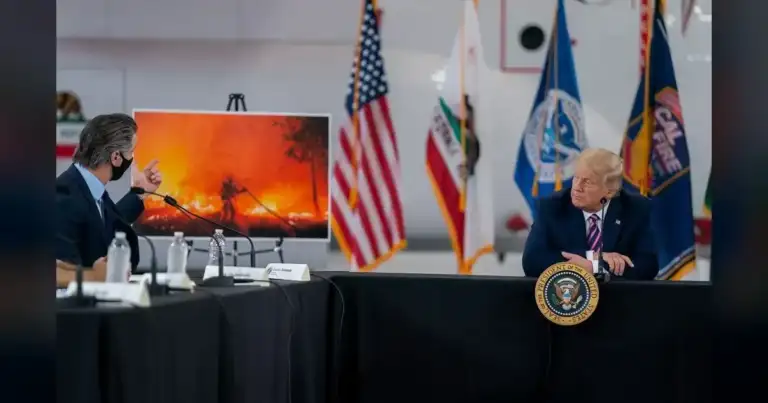
Photo: Photo by The White House on Openverse (flickr) (https://www.flickr.com/photos/148748355@N05/50345361806)
Source: Google News